
Blog

Whose roots?

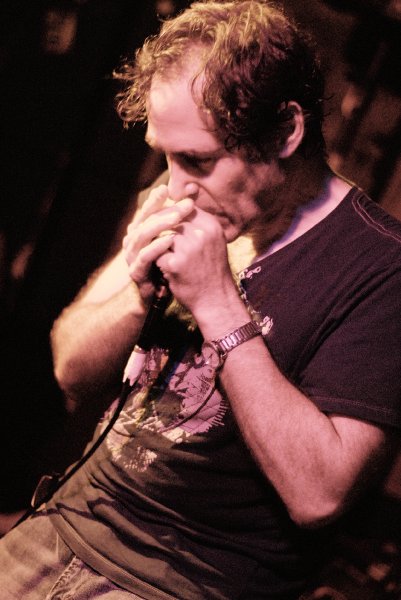
I did a short set about a week ago at the Dressing Room in Westport, CT, followed by a long jam with the house band and assorted guests. Richard Hunter with Lowlands The guests included a couple of guys in their mid-20s, one of whom played guitar, one of whom played piano, and both of whom sang.

What these guys wanted to play, all night long, was the music I was playing with bands when I was in my late teens and early 20s, about forty years ago: early Rolling Stones, Allman Brothers, late-60s Bob Dylan, and so on. It was eerie for me to think that this, rather than the music of their own era, was their preferred repertoire.

It’s not like I wasn’t an archivist too when I was their age. In the early 1970s I studied Swing and pre-Swing era soloists–Louis Armstrong, Lester Young, Coleman Hawkins, Ben Webster, Johnny Hodges, Charlie Christian, and so on–all of whom preceded me by close to forty years, the same time span that separates the guys I jammed with from the first appearence of their preferred music. But I was also immersed in the music of my own era–the music that I guess rock musicians now think of as “roots” music–and in the blues, whose prime exponents were still alive and very much active, though their most influential work, the work that formed the roots for my contemporary heroes, had been done decades earlier.

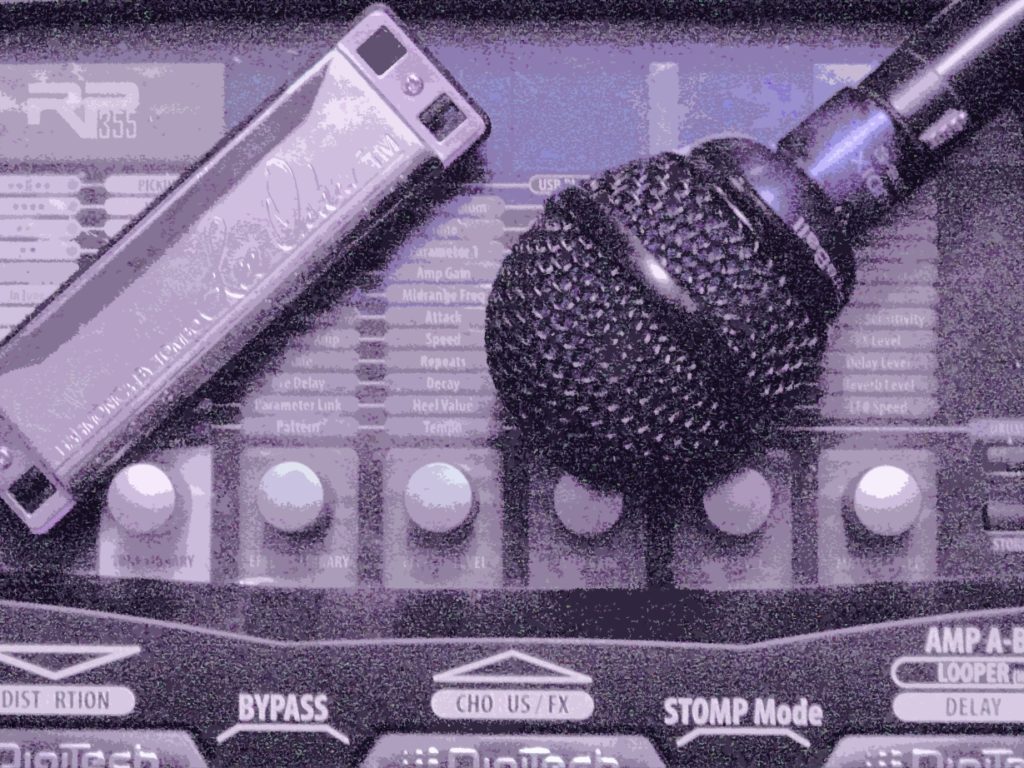
It’s strange to think that the contemporary music that I grew up with is the stuff these guys think of as their roots. (One of them told me that my harp work, coming through the RP355′s Leslie effect, reminded him of Garth Hudson with the Band. No more recent reference point?) It’s a little weird, too, to think that the best stuff in the rock genre was apparently the first. But maybe that’s the way it’s always been. Did anyone do bebop better than Charlie Parker? John Popper once said that Arnie Lawrence, the saxophonist who was one of his first teachers, told him that the first cry from a baby’s mouth was the blues, and after that it was all showbiz. So maybe the draw that this music has for the young men I played with last week is that it’s the first cry, and the last before showbiz took over completely. Which, as American Idol, X Factor, and The Voice demonstrate, it has. Whatever else those shows are about, they are not about new and daring repertoire.

Blog, Recommended Artists & Recordings

Video of the day 1 February 2012: Brendan Power/Jasmine Flower, live in Shanghai

Anyone who’s visited this site more than twice knows how much we love the work of Brendan Power. This strikingly beautiful performance of a traditional Chinese piece, “Jasmine Flower,” was recorded live in Shanghai in December 2011. Brendan is playing a Suzuki chromatic harmonica modified (by him) to enable the deep pitch bends that are characteristic of traditional Chinese music. (Brendan is apparently never averse to modifying his harps as radically as necessary to make them more playable in a given musical context. As PT Gazell, who recorded an entire album with Brendan, said to me once, “Who knows what harps Brendan is using?”) Beyond the gorgeously executed simplicity of the performance, what is most striking is how perfectly the harmonica fits into this traditional Eastern music.

Blog, Hunter's Effects, Recommended Gear

My first session with the Digitech RP255 as recording interface

Ed Abbiatti, the leader of the great Italian rock band Lowlands, asked me to play on several cuts on his upcoming CD, scheduled for release in early 2012. I did the first sessions in my home studio, using a Line 6 UX2 audio interface and Line 6′s Amp Farm software to do the amp modeling. After Ed heard the tracks, he asked me to lay down a hook riff on one of the pieces too. The only problem was that the deadline was Jan. 21, and by that time I was in Idaho, far from my home recording setup.

Ed Abbiati, Richard Hunter

What I did have with me was the Digitech RP255. I’ve written previously about the fact that the RP devices function pretty well as audio interfaces, and this was the acid test. I set up the 255 with a tough Fender Bassman patch, plugged it into the computer via USB, and set to work.

I’ll cut to the chase: I was very happy with the sound of the tracks I laid down with the RP255, and Ed is too. Of course I couldn’t easily get EXACTLY the same sound on the RP that I got with the Line 6 software, so to make things easier for the mix engineer I re-recorded the entire part, not just the new hook riff. The RP did its job both as an amp modeler and as an audio interface; my audio recording software (Cakewalk Sonar 8.5) was very happy with the RP from the start, and the recording process was utterly glitch-free. It’s even more impressive when you consider how finicky my laptop is when it comes to recording; most of the interfaces I own just can’t operate with the low latency that’s needed for recording against a guide track, but the RP cruised right along.

I don’t think the RP is going to be my go-to computer audio interface, at least not in the immediate future, but it’s nice to know that I can make usable tracks with it when I need to. I’ll ask Ed if I can post a snippet or two of the tracks for all to hear. In the meantime, if you’ve got an RP, you’ve got a decent computer audio recording interface.

Digitech RP355
DigiTech RP355 Guitar Multi-Effects Pedal with USB

Blog

Missed the One Ton Pig show, but had a great gig with George Kilby Jr.

A conflict prevented me from showing up for the One Ton Pig show tonight (Jan. 17) at the Silver Dollar in Jackson WY, but I had a great gig earlier today with George Kilby Jr. George is a very experienced and accomplished blues guitarist and singer, based in New York, whose impressive resume includes a lengthy stint with Pinetop Perkins and upcoming tours with harmonica master Phil Wiggins.

George Kilby Jr.

I performed with a topnotch band of Jackson-based musicians backing George–Andy Calder, one of my favorite bass players anywhere (and coincidentally the bass player for One Ton Pig), Ed Domer on drums, and Ron Harvey on keys and backup vocals–in a one-hour show at the Jackson Hole Community School that laid out the story of the blues in American music, from field hollers through James Brown and rap. It was a lot to cover in an hour, and the material certainly demanded a lot of different approaches. No time for boredom at this show…

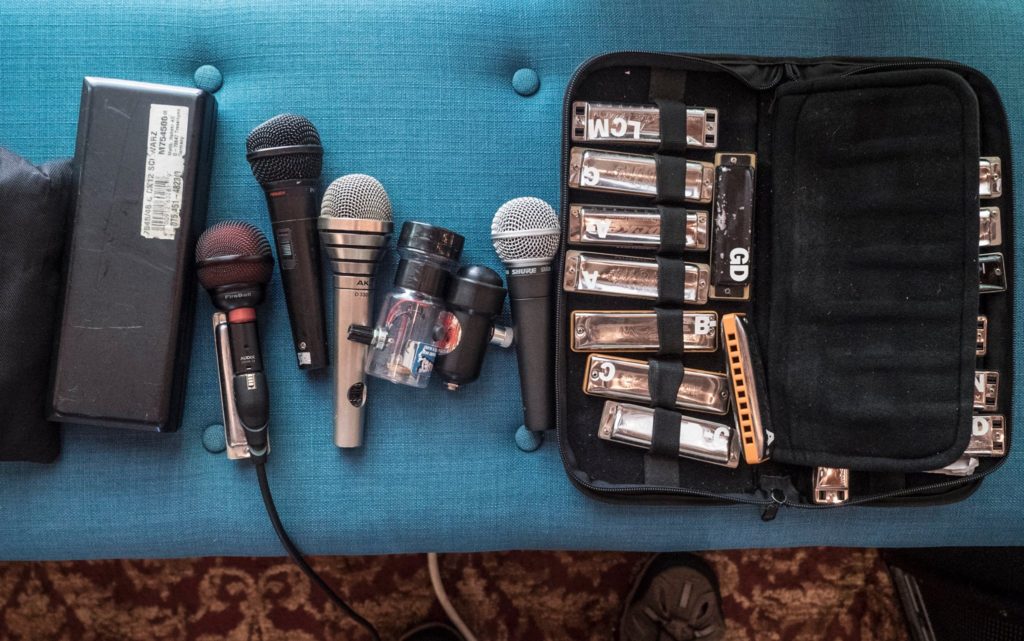
I came by this gig by chance–I just happened to be in town when the show came up, and I was glad to make myself available. By good fortune, I had packed two mics, a Digitech RP255, and my casual harp kit with 14 diatonics and a chromatic for this trip, and I had a Peavey KB2 amp ready to go in Idaho, so I had everything I needed to play. As it turned out, I only needed four harps for the show–standard diatonics in C, D, G, and A–so I was well prepared on the gear side. The RP255 and Peavey combination sounded great, and I had plenty of headroom on the amp to work with. (I could have gone straight to the PA, but I didn’t know who would be handling sound for the show, so I decided to bring the amp.)

This is the first show in which I’ve used two mics: a Bottle o’ Blues and a Fireball V. I think it’s going to be my standard setup from now on. The BoB gave me utterly filthy amped tones, and the Fireball was great for everything else. The only thing I’ll add in future is an A/B pedal so I don’t have to plug and unplug the mics every time I switch.

The night before the show, I took half an hour to set the RP255 up with several of my amped blues patches, a low octave double patch, a rotary speaker patch, and a few FX-only patches with reverb and/or delay. In performance, I ended up using four patches: a plate reverb (for the acoustic harp sounds), the low octave double (for the saxophone head on “Choo Choo Ch’Boogie”), the rotating speaker patch (for the New Orleans number “Iko Iko”), and an amped blues patch based on a Fender Bassman model (for a couple of blues pieces, including Chuck Berry’s “Maybelline”). It was great to have so many cool sounds to work with in such as simple setup, and the variety of tones was obviously exciting to everyone involved. That RP is SUCH a cool box. How else do you drop 60 different setups into a shoulder bag and carry it onto an airplane?

Anyway, it was a fun gig, and I’m looking forward to working with these guys again. The only thing I regret is that I remembered to turn my Zoom H4 recorder on, but I didn’t remember to press the “record” button twice, so there’s no recording of the gig. D’oh! So you’ll just have to take my word for it: it was, like, an epic win.

Blog, Pro Tips & Techniques

Hohner releases professional quality harmonica service videos aimed at the player

The post below is copied verbatim (with permission) from a message by renowned harmonica player Steve Baker to the Harp-L list. We agree with Steve that it’s important news for harmonica players. His message follows.


Steve Baker


In an unprecedented step for a major harmonica manufacturer, Hohner has released a whole series of professional quality harmonica service videos aimed at the player which have now been uploaded to the links below.

Demonstrated by Gabriela Hand, head of chromatic harmonica manufacture in Trossingen and presented by myself (Steve Baker), these HD videos provide detailed information on many major aspects of harmonica maintenance and also introduce the new Hohner Instant Workshop toolset, designed to enable easy reed replacement in addition to all other maintenance operations covered in the videos. The overall concept is the brainchild of Hohner Service Department head Michael Timler and the official launch will take place at NAMM.

Though primarily dealing with the chromatic harmonica, many of the subjects covered in the videos such as tuning, centering, reed offsetting or reed replacement are applicable to all types of harmonica and will undoubtedly be equally useful for diatonic players. The tools and techniques presented here will also be invaluable for harmonica technicians and may well revolutionize harmonica repair by rendering it accessible to everyman. In an era where more and more commodities are seen as being disposable, it’s a welcome sign that things don’t always have to be throwaway!

Here are the links to the individual videos:

C01 http://www.youtube.com/watch?v=c7Dc3ssh_bM

C02 http://www.youtube.com/watch?v=mDjJIluEX-g

C02.1 http://www.youtube.com/watch?v=4ju0FOZcCU4

C03 http://www.youtube.com/watch?v=8c9MUfhZWJM

C04 http://www.youtube.com/watch?v=wMlGCMwU8Ko

C05 http://www.youtube.com/watch?v=12cdfpp2Sg0

C06 http://www.youtube.com/watch?v=o9-31j2nPgE

C07 http://www.youtube.com/watch?v=pfC9OPmhyuU

C08 http://www.youtube.com/watch?v=-fVReyQfwA8

C08.1 http://www.youtube.com/watch?v=OMj9e853zIM

Blog

Upcoming performances: Tuesday 17 January in Jackson WY, and Friday 27 January in Westport CT

I have a couple of gigs coming up; mark your calendars now if you’re in the neighborhood.

Richard Hunter with LowlandsOn Tuesday, Jan. 17, I’ll be sitting in with my favorite Chicken Fried Prison Music band, One Ton Pig, at the Silver Dollar in Jackson, WY. I’m awaiting confirmation on another gig that day; stay tuned for more info.

On Friday, Jan. 27, I’ll be doing a short one-man set with my harps and my looper at The Dressing Room in Westport, CT. This’ll be one of my first performances featuring new material with the looper, and it should be a blast. The Dressing Room is a terrific restaurant as well as a stage, and the music starts around 8 PM. If you’re planning to have dinner, make reservations.

See you there!

Audio/Video, Blog, Recommended Artists & Recordings

Video of the Day 7 January 2012: Maria Joao Mendes with Wim Dijkgraaf

Wim Dijkgraaf is the Dutch-born jazz chromatic harmonica virtuoso behind the Effortless Harmonica Blog. He’s also a key member of Portuguese jazz singer Mario Joao Mendes’s topnotch Brazilian jazz band. This video is a promo for Mendes’s new CD; Wim’s harmonica kicks in at about 1:26, and it’s beautiful, powerful stuff. Check out the rest of the videos on her channel as well.

Audio/Video, Blog, Recommended Artists & Recordings

Video of the Day 31 Dec 2011: Climb Jacob’s Ladder, “Do the Funky White Boy”

This isn’t the first time I’ve featured a video from Climb Jacob’s Ladder, Paul Messinger’s killer band from North Carolina. This tune has a humorous lyric, but there’s nothing whimsical about the harp. Messinger uses at least three different sounds on this piece: he starts out running through his Crate VC508 tube amp, which is in turn output to the PA, then plays a pretty 1st position solo through the vocal mic, then adds a high octave doubler to the amped sound. Killer. This is one of the most exciting bands with harp in the world right now.

Happy New Year everybody!

Blog, Hunter's Effects, Recommended Gear

Gear Review: Tech 21 Blonde v2 Fender Amp Modeling Pedal

The Tech 21 Blonde (v2 in this case) is a stompbox amp modeling pedal designed to emulate a range of Fender amps, a role that it fills very well. It’s one of a series of “Character” pedals from Tech 21, whose experience building analog amp modeling pedals goes back to the original SansAmp a decade or so ago. Each of the “Character” series pedals is designed to emulate characteristic amp sounds for a particular manufacturer (such as Fender in the case of the Blonde, Vox, Mesa Boogie, etc.). Harmonica players have traditionally favored Fender amps for amped blues, so the Blonde is the likeliest pedal in the series to appeal to blues harp players.

At $169 retail, the Blonde is at the high end for pricing compared to single-amp-model competitors such as the Boss FBM-1 Bassman pedal and FDR-1 Deluxe Reverb pedal, but it’s also better-sounding and more versatile. Its controls are simple and effective, it’s practically noiseless in operation, and it runs on a 9 volt battery (or DC power with an optional adapter), which makes it fully portable and convenient for use at jam sessions and other situations where setup time is short. What’s not to like, aside from the fact that it doesn’t have any built-in FX?

Tech 21 Blonde v2

The blonde covers the basics without fuss or frills

As you can see from the picture, the Blonde’s controls are few and to the point:

  • Level: sets the output volume for the pedal.
  • Mid, Low, and High: sets EQ. The Mid band is set to 1 kHz, which is a good low-midrange zone for harmonica.
  • Drive: equivalent to the Gain control on a typical amp, this overdrives the preamp (or preamp modeling, in this case) for a grittier sound.
  • Character: this control has no equivalent on any other modeling pedal I’ve seen. Essentially, it shifts the tone in ways that mimic the characteristics of different Fender amps, from a Deluxe Reverb to a Bassman. My guess is that it adds modeled preamp and/or power amp tubes to the signal path as the knob is cranked up.
  • The Blonde has no reverb or delay. If you’re running the device through a PA or keyboard amp with either of these FX, you can use the effects in the amp (assuming you can get near the PA and understand quickly enough how to set the reverb/delay level for the harp, no easy trick at a lot of jam sessions). Regardless of whether you have FX available in your amp, you really should run the Blonde to a clean amp like a PA or a keyboard amp, not a traditional blues harp tube amp.

    In Use: Fender in a box

    Tech 21 helpfully supplies illustrations of a few useful knob settings, and I found the recommended Bassman setup to work well for harmonica without any adjustment. I tried a few variations on settings for Level, Drive, and Character, and found that I could get a range of usable tones, including some pretty hard-edged sounds. As usual for any amp modeler (or amp), changing any one of these controls demanded changes in the others too to avoid feedback and maximize tone. Speaking of feedback, the device will certainly howl if you push it hard, but it’s not especially feedback-prone. Bass response in particular seems very strong (in a good way).

    An unlabeled button on the front panel switches cabinet modeling (based on a 12″ Jensen setup) in and out. (By the way, what’s up with that no-label thing? A button as important as that ought to have something next to it that tells you what it does. Don’t be fooled by the picture above, which shows a small speaker symbol next to the button; I’m looking at my unit right now, and that symbol isn’t on it.) As usual for any amp, modeled or otherwise, without the cabinet the sound is plenty raw. If you like the sound of the cab you’re running the pedal through, that might be fine. I found that switching off cabinet modeling with the pedal connected to my Peavey KB-2 keyboard amp (with 10″ speaker) produced a big, barking tone that was similar to the bark of my Ron Holmes-modified Crate VC508 in side-by-side comparison. However, my guess is that running this device through a PA (or a powered PA speaker) without the cabinet modeling on would sound a little too raw for most players and most songs.

    The Blonde won’t turn on without a 1/4″ input plugged in, which is a good way to preserve battery life. I tested it with both the Fireball V and Bottle o’ Blues mics plugged straight into the input, and it produced big, meaty, tough tones with both.

    Value for Money is Strong

    The Blonde’s competition in this price range includes both multiFX devices like the Digitech RP255 and the Zoom G2NU, as well as the aforementioned Boss FBM-1 and DRM-1 pedals. The Blonde is definitely a better buy than either of the Boss pedals, given that it’s more versatile and better-sounding than both of them. The RP’s wide range of good-sounding amp models (including clean models) and FX makes it more versatile than the Blonde–it’s hard to get bored with the RP–but the Blonde gets an edge in at least some situations because it runs on battery. I also found the Blonde’s Bassman sounds to be just a little tougher than the Digitech’s (and more detailed than the Zoom’s harder-edged Bassman model), though both put out a big sound that’s plenty responsive to the player. In terms of ease of use, the Blonde is a winner for sure (though the RP is easy enough to use when you add my patch set).

    Of course, the ease-of-use comparison isn’t quite fair. The Blonde basically does one thing, while a multiFX device might be doing ten things at once. With a multiFX device you need to do your setup before the show–you need to think through the sounds you want and put them where you can use them, ready to go. You can’t adjust everything at once when you’re onstage, any more than you could do it with a chain of ten “real” FX pedals. The beauty of it is that once a multiFX device is set up with the sounds you want, you can achieve amazing changes of tone instantly–much faster than you could by adjusting physical FX pedals one by one.

    I use a lot of different sounds and FX in my performances; almost everything I do with the looper includes a layer that has an octave doubler, a rotary speaker, or a vibrato, and I like having those sounds available in a single device. I wouldn’t replace my RP355 with the Blonde for most performances, but I’m glad to have the Blonde for straight blues gigs, jam sessions and other situations where I want absolutely minimum setup time and at least one great sound to go to.

    I recorded a few samples with to give you an idea of the similarities and differences in the sounds of the Blonde and the RP355. I used the Fireball V mic on the former, and the Bottle o’ Blues mic on the VC508. Here’s the Blonde:
    Tech 21 Blonde with Fireball V mic into Peavey KB2

    And an amped-up sound on the RP355:
    RP355 Dark Blue Tweed with Fireball V mic into Peavey KB2

    Finally, just to show what a difference delay can make, here’s the RP355 running the RP355 Dark Blue Champ patch with delay engaged, again with the Fireball V mic:
    RP355 Dark Blue champ with delay engaged

    Summary: The Blonde is Harp-Friendly

    If all you want is a great Fender amp emulation, you want to keep things simple, and you’re ready to spend more for additional FX (starting with delay and reverb), this thing rocks. It does what it does very well, and it’s built to last. It’s basically like buying a good harp amp, with the same benefits and limitations (except that you can’t throw a harp amp into your knapsack to take it to the jam). Keep in mind that, as with any amp modeling device (and as previously noted), you should run the Blonde into a PA or other super-clean amp rather than a typical guitar or harp amp. Modeled amp distortion on top of tube amp distortion isn’t the best way to produce a usable sound, unless you’re playing harp for Nine Inch Nails.

    If you decide to get one of these devices and you don’t have a delay or reverb, check out this article on using the Digitech RP as a delay and reverb box. With my patch set, it’s easy and economical.

    Blog

    A few thoughts on the failure of Harrison Harmonicas

    Our post on Harrison Harmonicas going out of business provoked more comments from visitors than any other post we’ve written. One recent post said in effect that HH was a great idea that was killed by greedy market forces–an interesting idea, but one we take issue with in this post.

    The B-Radical was indeed a great product idea–a super-high-quality mass-manufactured diatonic harmonica. But there’s a big difference between a great product and a viable model for doing business. I haven’t talked to the principals at HH, but I think the basic idea behind their business model went something like this.

    A Guess at Harrison’s Business Model

    More and more harmonica players are buying harmonicas customized by craftsmen at prices ranging from $85-200 apiece. There is also an apparent market for high-end (and pricey) harmonica amps. All of this helps to confirm that there is a segment of harmonica players who have both the means and the desire to acquire very high quality, expensive instruments. (The size of this segment is of course an open question at this point, but Harrison apparently thought it large enough to pursue.)

    A manufacturing company is better suited to meet this demand at competitive prices with consistent high quality than is a craftsman/customizer, assuming that products can be sold in sufficient quantity to make economies of scale possible. A manufacturing company can build high performance into the design from the start, allowing the use of less-expensive labor in the manufacturing process, thus increasing margins along with manufacturing capacity. A manufacturing company is also better-positioned to tap markets in multiple geographies.

    So that was the basic idea: capture the high end of the market with a high-quality mass-manufactured product, using economies of scale to gain superior margins as well as wider distribution than any artisan could achieve.

    Why didn’t it work?

    The errors in Harrison’s Business Model

    HH was gambling that 1) the market for high-end harmonicas is large, and 2) there is a substantial segment of this market whose needs (for price, availability, etc.) are not currently met by the customizers, and who are willing to pay customizer prices for mass-manufactured instruments.

    In hindsight, both these assumptions seem questionable. First, I doubt that anyone really knows what the potential market size for high-end harmonicas is–and it may not be very large. Even many professionals, who should be the likeliest targets for high-end instruments, play out-of-the-box harmonicas priced in the $30-$50 range. Harmonica players seem to find it much easier to justify paying $1500 for an amp than they do paying $100 for a harmonica–and the initial Harrison models were priced at nearly twice that. Customer habits where harmonicas are concerned involve inexpensive instruments and frequent replacements; thinking of a single harmonica as a lifetime investment is new thinking indeed for most players.

    Second, HH assumed that they would displace the customizers (and expand the market for high-end diatonics) with a better value proposition. But in what ways exactly did the customizers fail to meet the needs of the market? And in what ways was Harrison’s value proposition superior? Most customers probably think the products the customizers produce are very good. Most well-known customizers have waiting lists for delivery, which is not unusual with handcrafted products that are made to order, and the customers seem to be okay with what they perceive as a relatively minor delay between order and delivery (so long as the customizer delivers when promised, which most seem to do). The only thing their customers would really like to change is the price. But Harrison didn’t attack the customizers with reduced prices; the B-Radical came in at the very top of the established price range for customized diatonics. Further, the wait time for delivery of a B-Radical exceeded wait time for a typical customized harmonica, and at least some customers experienced multiple missed delivery dates on orders, with some paying but never receiving the goods. In short, Harrison’s overall performance was not nearly competitive enough with the established customizers.

    Price was the biggest mistake

    The biggest mistake HH made is probably the pricing decision, which reflects both failed assumptions. Harrison’s price point made them less competitive with customizers, and extremely vulnerable to attacks from traditional manufacturers. We appreciate that the technology involved in the B-Radical may have made a lower price point impossible to achieve profitably; the solution to that problem might have been to scale back the level of technology in the instrument, as opposed to scaling up the price.

    Harrison took the reverse of the path for a “disruptive technology” described by Clayton Christiansen in his brilliant books “The Innovator’s Dilemma” and “The Innovator’s Solution,” both of which propose that disruptive technologies enter markets with low-priced products that are less functional compared to traditional alternatives, but easier to use, and which appeal to a new set of users with relatively low performance requirements, not established users seeking the highest possible performance. HH set out to upend the market from the top down; Christiansen argues that markets are disrupted from the bottom up.

    HH’s business model left it wide open to an attack from the bottom, which was carried out by the traditional players, whose strategy was clearly to deny HH sole access to upwardly mobile diatonic players. (UPDATE: Steve Baker’s comments on this post, which can be found below, show that Hohner’s strategy at least was not a direct response to HH. But the effects were the same.) Just as HH was getting its first production models out the door, Hohner, Seydel, and Suzuki attacked the market for higher-priced higher-performance harmonicas from a different and more price-aware angle: they used their economies of scale to manufacture significantly better-performing instruments with only moderately higher pricing. A Hohner Crossover sells for about $60, less than twice the cost of a Special 20, and is noticeably louder and more responsive than the latter; Suzuki and Seydel have also introduced higher-performance instruments selling in the $60 range. There are obviously far more potential customers for these mid-premium instruments than there are for instruments selling at $200 apiece, and the upsell is a lot easier, especially when the seller is an established brand that the customer knows well. Harrison thus found themselves competing with traditional manufacturers as well as the customizers, and the traditional manufacturers had economies of scale working for them throughout the value chain that were unavailable to Harrison.

    Economies of Scale Weren’t Available to HH Soon Enough

    It is possible that Harrison intended to reduce prices once production was in full swing, but it seems that they did not achieve the economies of scale they wanted as quickly as they wanted. It appears that parts of the manufacturing process demanded more labor, and more highly-skilled labor, than originally anticipated. As delivery dates slipped, the company hired more labor at higher prices in an attempt to catch up. This put Harrison in the position of carrying costs far beyond those of both typical customizers and traditional manufacturers, with little opportunity for higher margins or, indeed, higher volume.

    Harrison may also have been under-capitalized, and when you’re struggling to meet payroll, it’s tough to lower your prices.

    Poor marketing and service iced the cake

    Suppose a price of $200 wasn’t prohibitive for the market HH was trying to acquire? Leaving aside the question of how big the market is, to be viable HH had to demonstrate conclusively that their harps were absolutely the best-performing harps in their price range–indeed, at ANY price. Since there’s very little you can discern on a recording to distinguish one harp from another, players could really only experience the difference by playing the instrument. This means that HH needed to make instruments available to plenty of people quickly to build word of mouth, especially after early marketing efforts (not least appearences on CBS News) led to a surge of interest.

    Astonishingly, HH put very few instruments into the hands of established players, with mixed results. To be fair, most professional harmonica players have long-established relationships with traditional manufacturers, and HH probably found the pickings slim when it came to finding well-known players to champion their instruments. But the company’s performance in building word of mouth was not tops. Delivery of instruments was apparently random in the sense that care was not taken to prioritize early deliveries to professionals and opinion leaders who could promote potential buyer confidence in the company and the instruments. At least some customers paid for instruments without receiving them, and other customers reported that quality was variable, with some instruments performing brilliantly and others far from it. In the Internet age, negative news of the company’s customer service spread rapidly, and did not encourage masses of buyers to throw their money down–if indeed there ever were masses craving to spend $200 apiece on harmonicas.

    Conclusion: Too much, too soon

    Harrison tried to do a lot with the B-Radical, including establishing a new technology and creating a mass market for it at a 6x increased price point for starters. I think it was a lot to take on, and in the end the company did not have the resources to execute against their vision and fight off the traditional manufacturers attacking from the low end of the market at the same time.

    There may be a place in the market for a $200 diatonic. But I think Harrison, and harmonica players, would have been better served with an instrument incorporating some of the new design features at a price point in the $100-$125 range. This territory, I expect, will be mined by one or more of the traditional manufacturers in the near future–and they may well do so with designs that include technology licensed from whoever now owns Harrison’s intellectual property.

    And there is one other important lesson here: in the Internet era, your first product release had better live up to expectations, because whether it does or not, everyone who cares to know about it will, almost instantly.

    Next Page »