
Blog, Recommended Gear

So Long to the Big Amp, At Least For A While

My Peavey KB/A 100 started producing lots of bad sounds last night–crackles, pops, booming bass, sudden drops in volume. After 18 years, I guess it’s overdue for service. Anyway, I’m back to the KB2 for the moment. Depending on what it costs to repair the KB/A 100, I might be buying a powered speaker or two soon. Whatever I do to get a big speaker back in my performing life, I’m going to have to think about remixing the loops I use for backing tracks–my brief experience with the KB/A100 and its 15″ woofer showed me that there’s a lot more low frequency content in my loops than I was hearing with the KB2 and its 10″ speaker.

Peavey KB2 Amplifier: it’s what’s for gigging, at least for now
Peavey KB2 Keyboard Amplifier

Blog

In Memoriam Walter Joyce

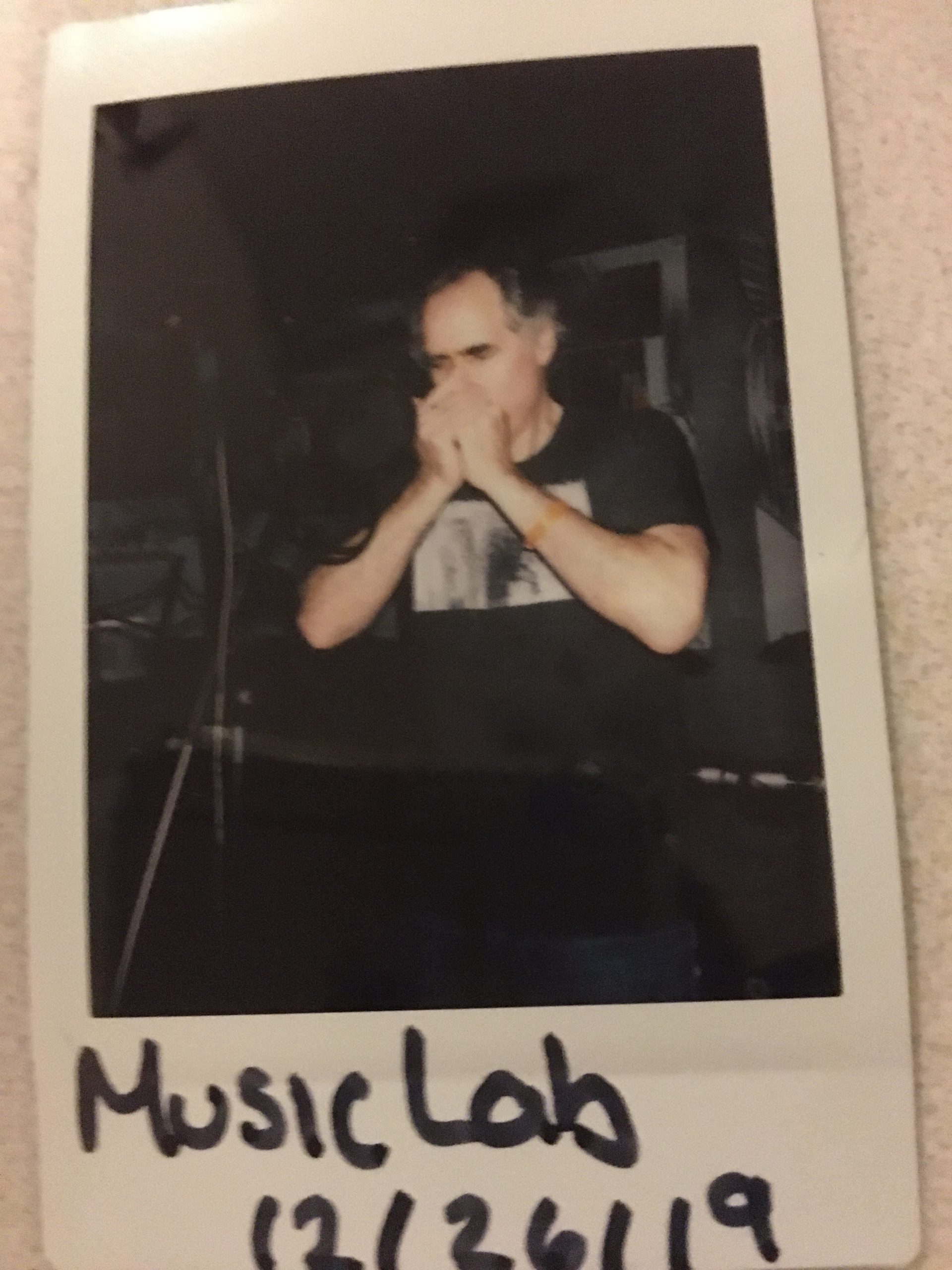
When I lived in Falmouth, MA, in the 1980s, I was close friends with Walter Joyce, who at the time was a pastry chef, and soon after taught karate for a living, before becoming a lawyer, which was the trade he was practicing when he died at work yesterday of a heart attack at the age of 58. Walter also played harmonica–he was in fact my student for a while–and he was one of the first players I ever heard playing independently from both sides of his mouth at once–simple stuff, but a very convincing proof of concept. We spent a lot of time hanging out together and talking about just about everything, especially music and martial arts, in those days.

RIP Walter Joyce

RIP Walter Joyce

Walter’s relationship with the harmonica, like mine, was lifelong once it started. So far as I know he was playing regularly with blues bands to the day he died. He had great wit and intelligence, and lots of talents. He had more, and more varied, careers than most people, and he attacked each one with zeal and skill. I was glad to know him, and I’m sorry he’s gone.

Most people’s deaths come too soon, and of course Walter’s did. You can learn more about him at his facebook page.

Blog, Hunter's Effects

Bit by Bit: Bringing the Boards Together

Now that I’ve got a basic layout for my two-amp modeler setup, I’m beginning the process of setting it up for fast, reliable load-in and tear-down. I started this weekend by painting the boards. Here’s what they look like with their fresh coat of red paint.

The pedal boards with their bright new coat of red paint

The pedal boards with their bright new coat of red paint

To transport each board and its load of pedals, I’ve ordered a soft case designed for a small keyboard. I considered a hard case, but at this point I’m not planning on flying around much with this rig, and a soft case is both less expensive and good-enough when you’re carrying your stuff in a car. (When I go on a plane, I just take the RP355–never mind the board.) I’ll test the case when it arrives later this week to make sure it’s snug enough for its cargo.

Finally, I’ve picked up another box of industrial-strength velcro, and I’m gonna velcro those pedals to those boards like nothing’s every been velcro’d to anything before. So by end of week I should have a setup that’s transportable and secure. The last step will be taking a close look at the cabling, and making every cable connection just exactly as long as it has to be (and no longer). Then I bundle the cables somehow so I don’t have to deal with dozens of loose cables at setup time.

At some point, I’ll probably swap out the Nady 4×1 mixer that’s at the apex of the two boards for a stereo mixer, so I can run the whole rig with a stereo mix. That’ll add two or three 1/4″ cables and a power supply to the complexity of the rig, not to mention a bigger chunk of mixer at the top. But that’s for later, and for now this setup is plenty good enough.

Where this all pays off is on the gig, when I can throw a complex setup down on the floor in a few minutes and have it work perfectly, and get it off the floor and into my car in a few minutes more. When all’s said and done, it’ll look good, sound good, and work good. And good is good.

Blog, Hunter's Effects, Recommended Gear

Bringing out the Low End with the Big Amp

I’ve been working with the two-amp-modeler Zoom G3 + Digitech RP355 setup for long enough now to know that my Peavey KB2 amp, with its brave but outgunned 10 inch speaker, isn’t going to cut it for the super-saturated low end frequencies that I’m laying down with this setup. So I’ve switched to my Peavey KB/A 100, which has more power and a 15″ woofer–big enough to handle all the low end I can throw at it.

Peavey KB/A 100 keyboard amp: notice the outline of the 15" woofer

Peavey KB/A 100 keyboard amp: notice the outline of the 15″ woofer

The main difference this makes in the rig is that the super-low frequencies I’m generating with multiple octave dividers don’t make the speaker crap out anymore. It also makes the rig heavier by about 20 pounds, but I guess my car can handle that, even if my back struggles to do so.

Not satisfied with upgrading the amp, I laid out a proof-of-concept pedal board this weekend; I bought a board, 1″ by 8″ by 6 feet, and cut it down to two boards, 29″ long each. I then velcro’d the pedals to the boards. Here’s what it looks like.

Pedals and boards--must be a pedalboard!

Pedals and boards–must be a pedalboard!

Putting the pedals on these things does a few things for me. First, it stabilizes the pedals, because they’re now mounted on something bigger and heavier, so they don’t move around. Second, I can scale the rig up and down quickly and easily. I can do two kinds of performances using just the right-side board: a typical band gig, where I use the RP355 alone; and a minimal solo gig, where I use just the RP355 and the JamMan Stereo. For a full-blown everything-I-can-do gig, where I want as much sheer sound-generating power as possible, I can take both the boards.

This must be getting serious if I’m figuring out how to put the stuff on stage and keep it there. Stay tuned for more on the evolving rig.

Blog, Hunter's Effects, Recommended Gear

My Two-Modeler Rig: A Few New Insights

I’m still developing patches for the Zoom G3, and I’m starting to think more about designing patches expressly to be used in combination with the Digitech RP355. (That’s a pretty selfish use of my programming time, given that I doubt most of my customers will ever run these two boxes at the same time. But whatever. My time, my sounds.)
Read more

Blog, Recommended Artists & Recordings, Recorded Performances (live and otherwise)

A blast from my past, courtesy of Randy Singer

Randy Singer is one of the best-known harmonica players in Miami and thereabouts, and we’ve known each other since roughly 1980. Randy just unearthed the clip below and sent it to me, and I was glad to get it. It’s a solo I played on a live recording of a performance of Phil Gentile’s song “Hey Brother (Come On In)”, an uptempo tune in a gospel-ish style. The harmonica performance is flat-out all the way; nobody likes athleticism better than a young musician, and I was in my mid-twenties when I recorded this.
Read more

Blog, Hunter's Effects, Recommended Gear, Recorded Performances (live and otherwise)

Recording “Copper” Episode 19: An RP255 and a Fireball V Does It

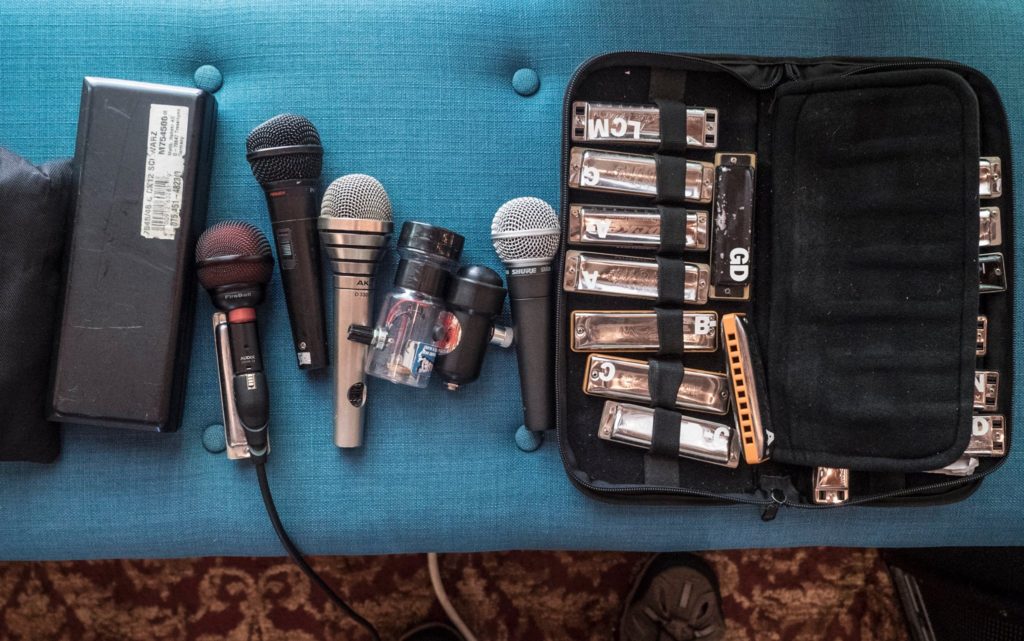
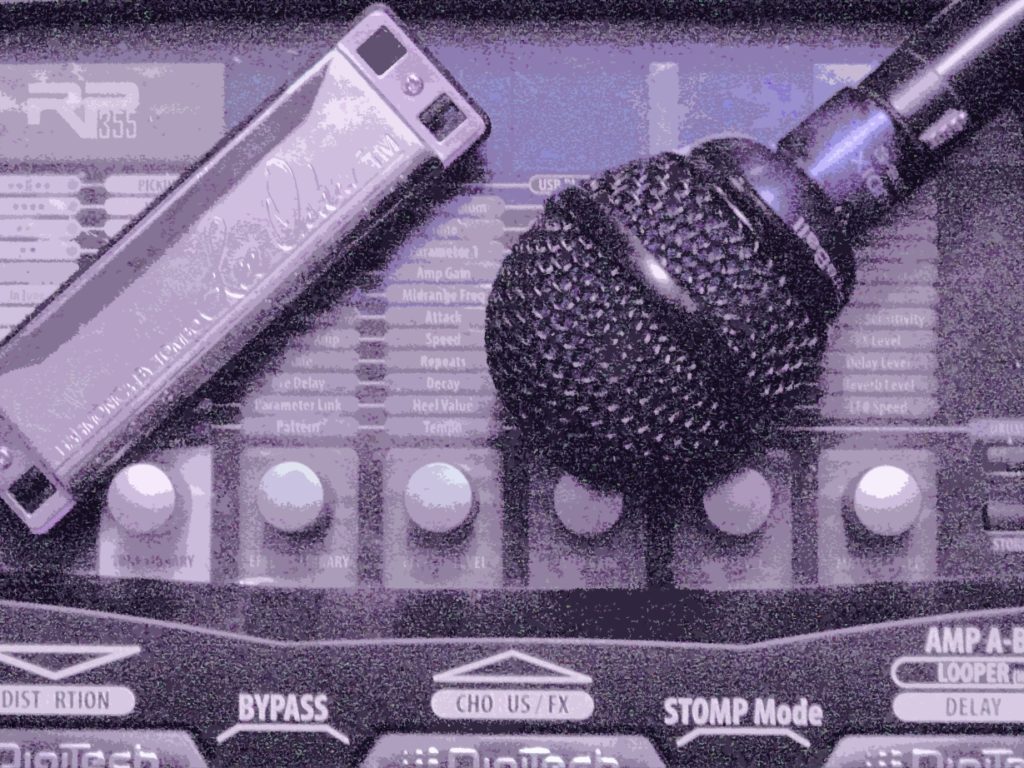
As I noted in a previous post, I got a call Friday night from Brian Keane, a composer and producer that I’ve done a number of sessions for. Brian wanted me to record acoustic harmonica for a scene in a BBC series he’s scoring called “Copper”, which is directed by Barry Levinson. I went over to Brian’s studio that night to get the concept right, and we set a studio date for today (Monday April 22, if you’re keeping track). Over the weekend I recorded three takes in my kitchen using an Audix Fireball V mic, a Digitech RP255 (connected to the computer via USB) for the audio interface, and my laptop computer, which is running Cakewalk Sonar 8.5. I exported the takes from Sonar and emailed them to Brian, and when I went to the studio today to do a few more takes on parts of the cue, I found that he’d already put together a composite track with the best bits from the tracks I recorded in my kitchen.
Read more

Blog, Recommended Gear

I’m Liking the Seydel Session Steel

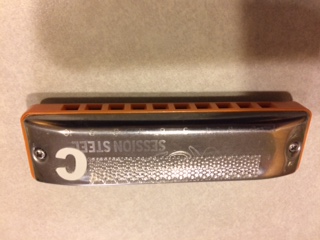
Last August at SPAH I bought a Seydel Session Steel harmonica in the key of A from Rupert Oysler. Since then I’ve been playing that instrument frequently and hard, and it still plays and sounds pretty much the way it did when I took it out of the case for the first time. That makes it the most durable instrument I’ve ever owned, not to mention louder, punchier, more responsive, and more generally playable than the vast majority of the harps in my collection.

I just took delivery on three more Session Steels in Bb, C, and D, and I’m looking forward to putting them through their paces. If they’re up to the standard set by the A harp, I’ll be very impressed. These harps aren’t exactly cheap, but they’re certainly price and performance competitive with the Hohner MB Deluxe and Crossover, Suzuki Manji and Olive, etc., and so far they seem to be more durable than any of the similarly-priced competition. (Certainly my MB Deluxes and Manjis don’t hold up under hard playing the way my A Session Steel does.) Stay tuned for more commentary as I work with my new Sessions Steels.

Seydel Session Steel diatonic harp

Seydel Session Steel diatonic harp

Blog, Recorded Performances (live and otherwise)

Getting all Emotional for “Copper”

I got a call last night from Brian Keane, a producer I’ve worked with on a number of projects. Brian is scoring this season of “Copper”, a BBC series about a detective in New York City in 1864, directed by Barry Levinson. The episode Brian is working on now (episode 19, in case you’re counting) has a scene with some VERY big emotions in it, and he’s decided to use harmonica as the lead instrument for the cue. Normally strings would do the job, but as Brian said to me once, in emotional terms, harmonica is the street version of a violin.
Read more

Next Page »