
Blog, Hunter's Effects

Bit by Bit: Bringing the Boards Together

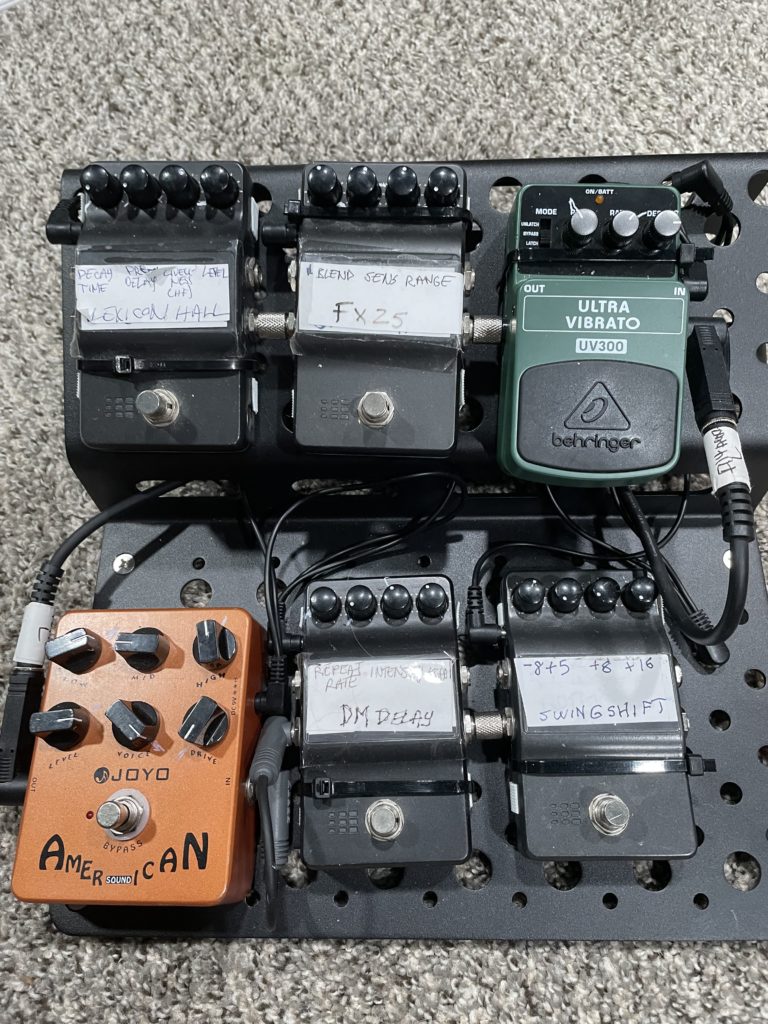
Now that I’ve got a basic layout for my two-amp modeler setup, I’m beginning the process of setting it up for fast, reliable load-in and tear-down. I started this weekend by painting the boards. Here’s what they look like with their fresh coat of red paint.

The pedal boards with their bright new coat of red paint

The pedal boards with their bright new coat of red paint

To transport each board and its load of pedals, I’ve ordered a soft case designed for a small keyboard. I considered a hard case, but at this point I’m not planning on flying around much with this rig, and a soft case is both less expensive and good-enough when you’re carrying your stuff in a car. (When I go on a plane, I just take the RP355–never mind the board.) I’ll test the case when it arrives later this week to make sure it’s snug enough for its cargo.

Finally, I’ve picked up another box of industrial-strength velcro, and I’m gonna velcro those pedals to those boards like nothing’s every been velcro’d to anything before. So by end of week I should have a setup that’s transportable and secure. The last step will be taking a close look at the cabling, and making every cable connection just exactly as long as it has to be (and no longer). Then I bundle the cables somehow so I don’t have to deal with dozens of loose cables at setup time.

At some point, I’ll probably swap out the Nady 4×1 mixer that’s at the apex of the two boards for a stereo mixer, so I can run the whole rig with a stereo mix. That’ll add two or three 1/4″ cables and a power supply to the complexity of the rig, not to mention a bigger chunk of mixer at the top. But that’s for later, and for now this setup is plenty good enough.

Where this all pays off is on the gig, when I can throw a complex setup down on the floor in a few minutes and have it work perfectly, and get it off the floor and into my car in a few minutes more. When all’s said and done, it’ll look good, sound good, and work good. And good is good.

Blog, Hunter's Effects, Recommended Gear

Bringing out the Low End with the Big Amp

I’ve been working with the two-amp-modeler Zoom G3 + Digitech RP355 setup for long enough now to know that my Peavey KB2 amp, with its brave but outgunned 10 inch speaker, isn’t going to cut it for the super-saturated low end frequencies that I’m laying down with this setup. So I’ve switched to my Peavey KB/A 100, which has more power and a 15″ woofer–big enough to handle all the low end I can throw at it.

Peavey KB/A 100 keyboard amp: notice the outline of the 15" woofer

Peavey KB/A 100 keyboard amp: notice the outline of the 15″ woofer

The main difference this makes in the rig is that the super-low frequencies I’m generating with multiple octave dividers don’t make the speaker crap out anymore. It also makes the rig heavier by about 20 pounds, but I guess my car can handle that, even if my back struggles to do so.

Not satisfied with upgrading the amp, I laid out a proof-of-concept pedal board this weekend; I bought a board, 1″ by 8″ by 6 feet, and cut it down to two boards, 29″ long each. I then velcro’d the pedals to the boards. Here’s what it looks like.

Pedals and boards--must be a pedalboard!

Pedals and boards–must be a pedalboard!

Putting the pedals on these things does a few things for me. First, it stabilizes the pedals, because they’re now mounted on something bigger and heavier, so they don’t move around. Second, I can scale the rig up and down quickly and easily. I can do two kinds of performances using just the right-side board: a typical band gig, where I use the RP355 alone; and a minimal solo gig, where I use just the RP355 and the JamMan Stereo. For a full-blown everything-I-can-do gig, where I want as much sheer sound-generating power as possible, I can take both the boards.

This must be getting serious if I’m figuring out how to put the stuff on stage and keep it there. Stay tuned for more on the evolving rig.

Blog, Hunter's Effects, Recommended Gear

My Two-Modeler Rig: A Few New Insights

I’m still developing patches for the Zoom G3, and I’m starting to think more about designing patches expressly to be used in combination with the Digitech RP355. (That’s a pretty selfish use of my programming time, given that I doubt most of my customers will ever run these two boxes at the same time. But whatever. My time, my sounds.)
Read more

Blog, Hunter's Effects, Recommended Gear, Recorded Performances (live and otherwise)

Recording “Copper” Episode 19: An RP255 and a Fireball V Does It

As I noted in a previous post, I got a call Friday night from Brian Keane, a composer and producer that I’ve done a number of sessions for. Brian wanted me to record acoustic harmonica for a scene in a BBC series he’s scoring called “Copper”, which is directed by Barry Levinson. I went over to Brian’s studio that night to get the concept right, and we set a studio date for today (Monday April 22, if you’re keeping track). Over the weekend I recorded three takes in my kitchen using an Audix Fireball V mic, a Digitech RP255 (connected to the computer via USB) for the audio interface, and my laptop computer, which is running Cakewalk Sonar 8.5. I exported the takes from Sonar and emailed them to Brian, and when I went to the studio today to do a few more takes on parts of the cue, I found that he’d already put together a composite track with the best bits from the tracks I recorded in my kitchen.
Read more

Blog, Hunter's Effects

Why I Spend Time Making Sounds for Harmonica Players

I want to be part of something that lives and grows in my own time, not something that stopped changing and growing 50 years ago.

That’s why I make sounds for the 21st century: so harmonica players can live there.

Blog, Hunter's Effects, Recommended Gear

Finding the Killer FX on the Zoom G3

As I continue with development of my patch set for the Zoom G3, I’m starting to find the killer FX on this box. For a start, I’m falling in love with the “M-Filter”, which is a filter based on Moog’s synth filters. It’s a neat and very adjustable filter that responds well to breath control. It’s very different from the filters in the Digitech RPs, and it works nicely with lots of amp models.

Zoom G3 multi-FX top view

Zoom G3 multi-FX top view

I’m also starting to explore the high-gain amp models in the box, like the Bogner (BG in Zoom-speak). With the gain cranked way up, it’s a heavy-metal amp for guitarists; turn the gain way down, and it produces a deep, rumble-y tone that’s well outside the ordinary for harp, in a very good way.

I’m still looking forward to playing with the Z-Clean amp model, which was one of the few things I really liked on the Zoom G2. On the G2, this model produced a sweet, clear tone with plenty of depth–a perfect platform for shimmering FX and straight-up country sounds.

The hardest part of developing sounds for this box is continually reminding myself that it is NOT a Digitech RP. I need to focus on what the G3 does brilliantly, as opposed to trying to make it sound just like the stuff I do on the Digitech. That means changing my mind, and as anyone who has ever tried to change a habit knows, your mind is the hardest thing to change there is. But I’m working on it.

Samples of these new sounds will be coming soon, so stay tuned.

Audio/Video, Blog, Hunter's Effects, Recommended Gear

Have You Tried My Un-Traditional Patches Yet? Neil Warren Did…

Neil Warren is the 2011 National Harmonica League (UK) Rock and Blues winner. He bought a license for our RP355 patch set last year, and he’s taken a big step recently. We’ll let Neil speak for himself:

Hi Richard,
there I was saying I couldn’t see myself using some of the more out-there effects on the RP355, then someone asked me to do a short little piece to go onto their website. A little playing with your latest patch set, and using the looping and overdub features of the RP355, I mixed the attached.

My first attempt at such harmonica technical wizardy, and I enjoyed myself, a lot! Will have to do more…

Here’s Neil’s piece. It’s short and to the point, and it illustrates something very cool about our patch sets: because the tones are so full of character, and the characters are so varied, you can layer them up in lots of different ways without obscuring the individual tones. In other words, you can make an ensemble that’s full of color and depth–all with your harmonica and an RP with our tones in it.

“Insurgent” by Neil Warren (copyright 2013 by Neil Warren, all rights reserved; used by permission)

We’re delighted that Neil shared this with us, and we’re especially pleased that he had so much fun putting this piece together. So for those of you out there who are using our Digitech RP patches to make traditional sounds: that’s great! Now try something different. You’ll be glad.

Blog, Hunter's Effects, Recommended Gear

The new patches for RP250/255/350/355 are here!

The latest (version 16) Huntersounds patch sets for Digitech RP 250/255/350/355 are now up for sale at our store. These sets will be available from our retail partners in a few days. All current licensees will get the new set via email this weekend (March 2-3 2013). All expired licensees will be offered the chance to renew their subscription for a $10 fee. (Note: the current RP150/155 patch sets have not changed. RP150/155 users needn’t worry; the latest RP150/155 sets were the starting point for many of the patches that appear in the v16 sets.)

The new sets take a different approach than my previous sets. It was clear to me that the vast majority of patch set buyers just couldn’t use all the sounds I included in previous sets, which was wasteful for all concerned. So these sets include fewer sounds, designed to cover the vast majority of playing situations. The new RP350/355 sets include 35 patches, which are repeated in the same sequence twice to fill the RP350/355 user area. The RP250/255 sets include 30 patches, also repeated to fill the user area. These patches are the result of over ten years of work on these devices, and they are big, bold, and powerful.

You can download a complete current layout and description of each of our latest patch sets for Digitech RP250/255/350/355 by clicking on one or more of the links below.


RP355 Huntersounds v16 Patch List
RP350 Huntersounds v16 Patch List
RP255 Huntersounds v16 Patch List
RP250 Huntersounds v16 Patch List

This layout has a couple of advantages. It ensures that your favorite sound is never far away, no matter where you’re currently positioned in the RP’s patch list. It also makes it easier to experiment with new sounds without overwriting your favorite sounds. Finally, it makes pricing crystal clear: the licensee pays $1 per patch.

In the near future, we will offer licensees add-ons in the form of 5-patch packages aimed at specific applications and styles. We think this will make it easy for RP users to add exactly what they need to configure their RPs for exactly the music they want to play.

You can hear samples, check out the patch set lists, and more at http://hunterharp.com/store.

Enjoy!

Blog, Hunter's Effects, Recommended Gear, Recorded Performances (live and otherwise)

Looping the Big Sounds: Like, wow

I’ve been putting loops together using the Zoom G3 and Digitech RP355 running in parallel, and the sounds are amazingly big and colorful. The samples below, recorded directly to my Digitech Jamman Stereo, then exported as 16 bit WAV files, speak (loudly) for themselves. The chain starts with a Fireball V mic, followed by an ABY box, where the signal is split and sent to a Zoom G3 and a Digitech RP355, running in parallel. The outputs from the G3 and the RP355 go to the channel 5-6 and 7-8 inputs of a Behringer UB802 mixer, along with the output from the TC-Helicon Voicelive Play (for vocals), which goes to one of the mic channels. The stereo main outs from the UB802 go to the stereo inputs on the JamMan Stereo, and the JamMan Stereo puts out a mono signal to a Peavey KB2 amp. (I want a stereo setup sometime soon.) The amp is recorded with a Zoom H4, positioned about six inches from the center of the speaker grill.

These samples are copyright 2013 Richard Hunter/Turtle Hill Productions/ASCAP, and all rights are reserved. Enjoy listening.

2ndLine+AutoWah
A short sample of a funky NOLA rhythm with a juicy RP355 FX25 autowah. Autowah seems to work for harp, period.

WizofOzSloDwn
A short three-harp piece, all parts played on a Db country-tuned Suzuki Manji. One part, again with multiple pitch shifters and vibrato, is played with the G3, and it traces the notes of an Eb major 6th chord, then the same shape a major 2nd down. (It’s played in 3rd position, which is major on a country-tuned harp.) Another part plays midrange chords and melodies with a much more transparent RP355 sound; finally, a double-octave-down RP355 patch is used with a 12th voicing on the 1-6 draw and blow notes. The sound as a whole is deep, beautiful, and new; in fact, it’s a new sound for any ensemble.

Dig.

Audio/Video, Blog, Hunter's Effects, Recommended Artists & Recordings, Recommended Gear

Videos of the Day 25 Jan 2013: Andi Martin’s Youtube Channel

Andi Martin is a strong blues harp player based in Madrid who’s using a Digitech RP355 loaded with my patch set in his live performances. We like it. You can hear one of his performances in the video below. Check out Andi’s Youtube Channel (canal de andimartinbluesharp) for more.

Next Page »